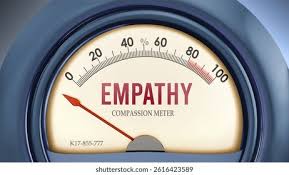
The Empathy Crisis
The US is in the midst of an Empathy Crisis
Since 2016, there has been a steady decline in the willingness of people to understand the perspectives of others, especially those they disagree with.

As a result, the willingness of people in this country to connect with and understand the experiences of others is steadily declining. For most Americans, certainly the priority is given to personal needs and struggles. But in these times, too often those personal values and beliefs, and the individual’s culture, social economics and other life situations and circumstances are fed by fear.
Without empathy, there is no curiosity about what the lives of others might be like. What it might be like to “walk in their shoes”. There is no interest in knowing what it feels like to live in the other’s circumstances and the environment in which they live.
This type of curiosity is called perspective taking and it creates a better understanding of what another’s experience might be like. This builds empathy for others. It requires cognitive empathy, the ability to see another person’s perspective but in a logical and analytical way.
The difficulty is that perspective taking requires intentional effort.
Lack of empathy is the root of the divisiveness we’re now experiencing in this country. Too many Americans, regardless of where they stand on issues, refuse to consider why others feel and behave as they do. Too many just decide to dislike, often hate, the other, often doubling down on demonizing them.
Acknowledging and respecting the beliefs, values, and behaviors of others is indeed important, but it can only go so far. It requires one to
- Have a willingness to recognize the possibility that “you don’t get it”
- Avoid labeling people and groups
- Accept that you may be clueless about another’s life circumstances
Perspective taking applies the Platinum Rule. It expands the Golden Rule to treat others the way they want to be treated. Therefore, we must first understand what that entails, hence the importance of curiosity. Considering the possibilities rather than drawing conclusions.
Cultural Humility (CH) is what it takes to be inclusive of anyone or any group regardless of whether we like or agree with them. For example, white male Christian nationalists, progressives, ANTIFA, the administration in power, the rich, the poor, immigrants, all of which are labels.
CH is the practice of mindful attention to the feelings and experience of others. Raising awareness of blind spots, we become more conscious of judgement of others and our automatic responses. And in these times, our beliefs about the messages coming at us from all types of media – television, news, social media.
Practices for Developing Cultural Humility
- Make time for face-to-face interactions: Social interaction and engagement fosters empathy
- Get more exposure: Seek opportunities that can provide different viewpoints and experiences
- Have compassion for others: Remember to have the compassion that you, yourself, would like to receive
- Practice the Five Habits of Empathic People
- Switching on the empathic brain
- Making the imaginative leap
- Seeking experiential adventures
- Practicing the craft of conversation
- Traveling in your armchair
- Practice Work/Life Mindfulness
- Our biases become lenses. Make sure your lens is clear.
- Put some space between you and your reactions
- Pay attention to the small stuff
- Check how you’re seeing before you try to change what you’re seeing
- Stop to examine how you typically respond to situations.
- Create space for more creative and flexible responses
- Pay attention to the small stuff.
- Consciously meet experiences, big and small
- Bring choice, attention, and awareness back into things that you’ve allowed to become automatic
- Make a habit of it
- Formal and informal practices of mindfulness extend mindfulness into everyday life
- Weaken the grip of our conditioning
Leadership and Cultural Humility
Effective leaders at any level of an organization tend to have high emotional intelligence (EQ) and high-performing teams. The EQ characteristic most important to CH is cognitive empathy – the ability to see another person’s perspective but in a logical and analytical way.
Leaders with cognitive empathy are inclusive, appreciating the perspectives diverse members bring to getting things done. They take a servant leader approach that prioritizes the personal and professional growth of others.
Leaders without EQ can cultivate toxic team and organizational cultures because they fail to model the positive and influential behaviors characteristic of EQ – self-awareness, self-management, social awareness (empathy), and relationship management.
Enhance and Apply Empathy
I am a conversation starter and Empathy Doula. I start with conversations because I want to hear your story. What follows when you begin a statement with “I am”?
Traditionally, a doula provides physical, emotional, and informational support to individuals and their families during pregnancy, childbirth, and the postpartum period. As an Empathy Doula, I support your desire to develop your empathy and cultural humility and put them into action to improve your wellbeing, however your story defines it.
When you’re reading to get started, contact me at drolivia@herrifordconsuling.com.
Expect good things!
Olivia